Tuesday, December 27, 2022

TESLA STOCK PRICE CRASH


TESLA STOCK  PRICE CRASH.

Elon Musk's  electric car company is days away from closing out its worst month, quarter and year on record .The latest drop comes after The Wall Street Journal reported that Tesla will continue a weeklong production halt at its Shanghai facility, facing a fresh onslaught of Covid cases within its Chinese workforce.


Tesla shares have fallen 71% from their record high in November 2021. For the month of December, Tesla has plunged 44%, by far its worst month ever, as it had never fallen more than 25% in a single month.

Twitter is bleeding cash, and Musk is selling Tesla stock in big chunks. According to filings in mid-December, Musk sold about 22 million more shares of Tesla, which were worth around $3.6 billion, Earlier this year, Musk told his millions of followers on social media that he had "no further TSLA sales planned" after April 28.

After his latest stock sale, Musk said on Twitter Spaces on Dec. 22 that he would not be selling any stock for 18 to 24 months. In a debate with a Tesla shareholder, Musk pinned Tesla’s declining share price on Federal Reserve rate hikes, tweeting that “people will increasingly move their money out of stocks into cash, thus causing stocks to drop.” Many are criticizing musk on Twitter and other platforms.

Meanwhile, on Twitter, Musk has continued to flirt with controversy, welcoming back previously banned users, enabling the continued releases of internal messages related to the company’s past handling of Covid and election-related content, and flip-flopping on policy changes. Companies have paused or suspended paid advertising on the platform

Last week, Tesla expanded discounts in North America for buyers of Model 3 and Model Y electric vehicles. Those discounts came after the automaker offered incentives in mainland China for December auto sales earlier this month.

According to Forbes, Tesla investors want Musk to refocus his efforts on stabilizing the company that accounts for the vast majority of his wealth. Because of the extended sell-off, Musk ceded his title as the world’s richest person earlier this month to LVMH chair and CEO Bernard Arnault.


Saturday, December 24, 2022

THE STOCK MARKET.

 THE STOCK MARKET.


The stock market is a financial market where publicly traded companies' stocks (also called shares) are bought and sold. It is a public market, meaning that anyone can buy and sell stocks, as opposed to a private market where trading is restricted to a smaller group of investors.
The stock market allows companies to raise money by selling stocks to the public, and it allows investors to buy and sell these stocks in the hopes of making a profit. The value of a company's stock is determined by supply and demand for the stock in the market. When more people want to buy a stock (demand) than sell it (supply), the price of the stock increases. Conversely, when more people want to sell a stock than buy it, the price decreases.
There are several major stock markets around the world, including the New York Stock Exchange (NYSE) and the NASDAQ in the United States, the Tokyo Stock Exchange and the Hong Kong Stock Exchange in Asia. Many people trade stocks through online brokerage firms or through investment advisors.
It's important to note that investing in the stock market carries some risk, as the value of stocks can fluctuate widely over time. It's a good idea to diversify your portfolio and to consult with a financial advisor before making any significant investments.

MARKET RISK

Risk refers to the possibility that an investment in the stock market will not achieve its expected return or will result in a loss. There are several types of risk that investors should consider when investing in the stock market:
Market risk: This refers to the risk that the value of an investment will fluctuate due to changes in the overall market. For example, if the stock market as a whole declines, the value of an individual stock may also decline, even if the company's performance remains strong.
Volatility risk: This refers to the risk that the value of an investment will fluctuate significantly over a short period of time. Stocks can be more volatile than other types of investments, such as bonds or cash.
Company-specific risk: This refers to the risk that a specific company will underperform or experience financial difficulties, which could lead to a decline in the value of its stock.

Political risk: This refers to the risk that changes in government policy or economic conditions could negatively impact the stock market or a specific company's performance.

Inflation risk: This refers to the risk that the value of an investment will be eroded over time by inflation. Inflation can reduce the purchasing power of an investment, which can impact its return.
There are several ways that investors can manage risk in the stock market, including diversifying their portfolio, investing in different sectors and industries, and using risk management strategies such as stop-loss orders. It's important to carefully consider the level of risk that you are comfortable with and to choose investments that align with your risk tolerance and investment goals.

FINANCIAL DATA.

 FINANCIAL DATA.


Financial data refers to information related to the financial performance, financial position, and financial health of a company or organization. This can include a wide range of data points, such as revenue, profit, expenses, assets, liabilities, cash flow, and much more. Financial data can be used to assess the financial health of a company, make investment decisions, and perform various financial analyses. There are many sources of financial data, including financial statements, public filings, and financial news websites. It is important to use reliable and trustworthy sources of financial data to ensure that you are making informed decisions based on accurate information.

Financial data refers to information that is related to financial markets and companies, such as stock prices, market indices, exchange rates, and company financial statements. Financial data can be used by investors, analysts, and businesses to make informed decisions about financial investments and performance.

Some examples of financial data include:

Stock prices: The price at which a stock is trading on a given day.
Market indices: A composite of the value of a group of stocks, used to measure the performance of a particular market or sector.
Exchange rates: The price at which one currency can be exchanged for another.

Company financial statements: Documents that report a company's financial performance, including income statements, balance sheets, and cash flow statements.

Financial data is often provided by financial news and data providers, such as Bloomberg and Thomson Reuters, and is also available from government agencies, such as the U.S. Securities and Exchange Commission (SEC).

Tuesday, May 30, 2017

Venezuelan opposition condemns Goldman for $2.8 billion bond deal


Venezuelan opposition condemns Goldman for $2.8 billion bond deal


By Brian Ellsworth and Davide Scigliuzzo | CARACAS/NEW YORK
(Reuters/IFR) - Goldman Sachs Group Inc's statement that it never transacted directly with the government of Venezuelan President Nicolas Maduro when it bought $2.8 billion of bonds for pennies on the dollar was dismissed by the country's opposition on Tuesday as an effort to "put lipstick on this pig."
Goldman, in a statement late Monday confirming the purchase, said its asset-management arm acquired the bonds "on the secondary market from a broker and did not interact with the Venezuelan government."
The New York-based investment bank came under fire from Venezuelan politicians and protesters in New York opposed to Maduro, who said the deal provided the cash-strapped government hundreds of millions of dollars in badly-needed hard currency. The deal, first reported by the Wall Street Journal, made Goldman complicit in alleged human rights abuses under the government, they said.
"As hard as it may try, Goldman Sachs ... cannot put lipstick on this pig of a deal for Venezuelans," the head of the opposition-led congress Julio Borges said.
Goldman Sachs did not respond to an email requesting comment on Borges' statement. In its original statement, Goldman had said: "We recognize that the situation is complex and evolving and that Venezuela is in crisis. We agree that life there has to get better, and we made the investment in part because we believe it will."
The opposition-led National Assembly later on Tuesday voted to ask the U.S. Congress to investigate the deal, which they called immoral, opaque, and hypocritical given the socialist government's anti-Wall Street rhetoric.
Goldman shares fell nearly 2 percent on Tuesday and were the biggest drag on the Dow Jones Industrial Average, which fell 0.24 percent.
"31 CENTS ON THE DOLLAR"

left
right
Protesters demonstrate outside of Goldman Sachs headquarters after the company purchased Venezuelan bonds, in New York, U.S., May 30, 2017. REUTERS/Lucas Jackson
1/9
With Venezuela's inefficient state-led economic model struggling under lower oil prices, Maduro's unpopular government has become ever more dependent on financial deals or asset sales to bring in coveted foreign exchange. Venezuela's international reserves rose by $749 million on Thursday and Friday, reaching around $10.86 billion, according to the central bank.
In New York, about two dozen protesters chanting "Shame on you Goldman Sachs" picketed outside of Goldman's headquarters in lower Manhattan on Tuesday afternoon.
"By giving $900 million to a dictatorship, they are funding a systematic human rights violator, they are funding immorality and for Maduro to stay in power while he keeps killing people," said Eduardo Lugo, 23, a Venezuelan attending college in New York and a leader of the protest.
Another protest was planned for Miami, home to a large community of Venezuelans who have fled the country's economy crisis, on Thursday.
In Venezuela, Maduro's critics have for two months staged street protests, which have left nearly 60 people dead, to demand he hold early elections. Maduro says the protests are a violent effort to overthrow his government, and insists the country is the victim of an "economic war" supported by Washington.
Meanwhile, emerging market bond market participants familiar with Venezuelan debt said there was no effective secondary market for the bonds in question, which were first issued by the state-owned oil company PDVSA [PDVSA.UL.] in 2014 and held entirely by the country's central bank until recently.
Goldman paid 31 cents on the dollar for the bonds, which mature in October 2022, Borges' letter said. At that price, the bonds would yield more than 40 percent compared with their stated coupon of 6 percent.
Goldman acquired the bonds from Dinosaur Financial Group, two sources familiar with deal told Reuters.
A person answering the phone at Dinosaur's New York office said the firm had no comment on the matter.
Opposition lawmakers said they wanted to investigate intermediaries in the deal.
"We're going to put a magnifying glass on this financial middleman. This small company called Dinosaur, who is behind it, what power does it have?" said lawmaker Carlos Valero before the vote.
One U.S. broker deeply involved in trading Venezuelan securities told Thomson Reuters IFR that fair value for the bonds should be around 44 cents to 46 cents on the dollar, based on where other bonds issued by PDVSA and the Venezuelan government were trading on Tuesday.
The broker said he did not expect the bonds to trade unless Goldman chose to sell them. At $2.8 billion of face value, the firm now owns the vast majority of that series of bonds originally issued by PDVSA, which totaled around $3 billion.
Most Venezuelan bond prices were up in Tuesday trading.
(Reporting by Brian Ellsworth, Corina Pons, Eyanir Chinea, and Alexandra Ulmer in Caracas, Marianna Parraga in Houston, David Scigliuzzo, Olivia Oran and Laila Kearney in New York; Writing by Dan Burns; Editing by Nick Zieminski and Andrew Hay)

Monday, April 3, 2017

Wall Street down on weak auto sales, doubts about Trump agenda

Wall Street down on weak auto sales, doubts about Trump agenda

Traders work on the floor of the New York Stock Exchange (NYSE) shortly after the opening bell in New York, U.S., March 22, 2017.  REUTERS/Lucas Jackson
Traders work on the floor of the New York Stock Exchange (NYSE) shortly after the opening bell in New York, U.S., March 22, 2017. REUTERS/Lucas Jackson
By Sinead Carew
Wall Street closed slightly lower on Monday as March auto sales disappointed and investors questioned whether the Trump administration would deliver on its pro-business economic stimulus.

Stocks had risen to record highs on Trump's promises to cut taxes, ease regulations and spend heavily on infrastructure, and investors hoped that his policies would boost the economy.

General Motors was one of the biggest drags on the S&P 500 .SPX after automakers' sales figures for March came in below market expectations, an early signal America's long car sales boom may finally be losing steam.

"The disappointing auto sales are something people are keeping an eye on and that's meaningful news," said Michael O’Rourke, chief market strategist at JonesTrading in Greenwich, Connecticut.

The major indexes pared losses. They had fallen sharply in morning trade after some U.S. states accused President Donald Trump's administration of illegally suspending energy efficiency standards.

The challenge came barely two weeks after Republican's had to pull healthcare reform bill due to a lack of support.

Also on Monday, Democrats amassed enough support to block a confirmation vote for Trump's Supreme Court nominee.

"If there's not one big reason (for the market decline), there's many little reasons. Right now I think it's a little reason day," said Brad McMillan, Chief Investment Officer for Commonwealth Financial in Waltham, Mass.

While investors still hope Trump can deliver on some of his agenda, they "are getting nervous and starting to discount some of the benefits they expected to see" said McMillan.

Adding to nerves was news of a explosion in a St Petersburg train tunnel that killed ten people on Monday in what Russian authorities called a probable terrorist attack.

Trump held out the possibility on Sunday of using trade as a lever to secure China's cooperation against North Korea, in comments that appeared designed to pressure Chinese President Xi Jinping ahead of their first meeting this week.

The Dow Jones Industrial Average .DJI fell 11.38 points, or 0.06 percent, to 20,651.84, the S&P 500 .SPX lost 3.8 points, or 0.16 percent, to 2,358.92 and the Nasdaq Composite .IXIC dropped 17.06 points, or 0.29 percent, to 5,894.68. Eight out of 11 major S&P 500 sectors were lower, led by the consumer discretionary index .SPLRCM 0.5-percent. The top three drags on that sector were auto stocks.

GM (GM.N) finished down 3.4 percent while O'Reilly Automotive Inc, a car parts retailer, fell 4 percent. Fiat Chrysler (FCAU.N) sank 4.8 percent and Ford (F.N) fell 1.7 percent.

ALSO IN BUSINESS NEWS

Elon Musk mocks short sellers after Tesla stock surge
U.S. factory activity cools slightly; trend remains bullish
Two indexes that gained were telecommunications .SPLRCL and real estate .SPLRCREC - defensive sectors whose predictable slow growth are popular in times of uncertainty.

The S&P 500 is trading at about 18 times earnings estimates for the next 12 months, above its long-term average of 15 a few weeks before earnings seasons starts.

Declining issues outnumbered advancing ones on the NYSE by a 1.32-to-1 ratio; on Nasdaq, a 2.56-to-1 ratio favored decliners.

The S&P 500 posted 18 new 52-week highs and 6 new lows; the Nasdaq Composite recorded 80 new highs and 33 new lows.

About 6.8 billion shares changed hands on U.S. exchanges on Monday, about matching the average for the last 20 sessions.

(Additional reporting by Yashaswini Swamynathan and Sweta Singh in Bengaluru, Rodrigo Campos in New York; Editing by Savio D'Souza and Nick Zieminski)

Friday, March 17, 2017

U.S. says Walt Disney subsidiaries to pay $3.8 million in back wages


U.S. says Walt Disney subsidiaries to pay $3.8 million in back wages


Two Florida subsidiaries of Walt Disney Co have agreed to provide $3.8 million in back wages to comply with federal law, the U.S. Labor Department said on Friday.
The wages will be paid to 16,339 employees at the two units -- Disney Vacation Club Management Corp and Walt Disney Parks and Resorts U.S. Inc -- after U.S. officials found violations regarding minimum wage, overtime and record-keeping, the department said.
"The Department of Labor has identified a group of cast members who may have performed work outside of their scheduled shift, and we will be providing a one-time payment to resolve this," a Walt Disney World Resort spokeswoman told Reuters.
Disney's Parks and Resorts unit operates its parks and resorts around the globe, including the Florida-based Walt Disney World Resort.
"We are adjusting our procedures to avoid this in the future," the spokeswoman said in an email.
(Reporting by Susan Heavey in Washington and Aishwarya Venugopal in Bengaluru; editing by Diane Craft and Maju Samuel)

Friday, March 10, 2017

South Korea impeachment: What happens now?

South Korea impeachment: What happens now?

  • 9 hours ago
  •  
  • From the sectionAsia

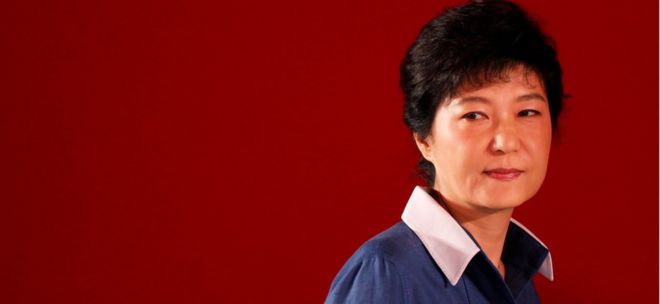
South Korea's impeached President Park Geun-hye (file image)Image copyrightREUTERS

A South Korean court has voted to uphold an impeachment vote against President Park Geun-hye.
The ruling means Ms Park becomes the first democratically elected president to be removed from office, and could face prosecution over corruption allegations.
So what does this mean for the country?

First, what just happened?


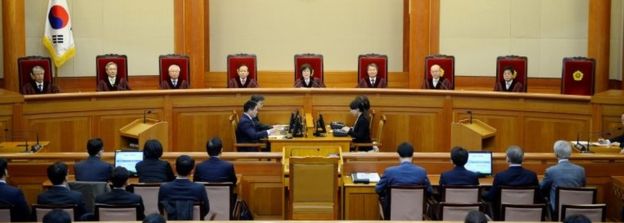
Supreme Court in South Korea (10 March 2017)Image copyrightREUTERS
Image captionThe unanimous nature of the court ruling could help reduce public disquiet

The constitutional court backed an impeachment vote by parliament last December. It said the now ex-president's actions had "betrayed the people's confidence" and were "a grave violation of law, which cannot be tolerated".
Those actions were her alleged collusion with her close friend, Choi Soon-sil, to pressure South Korean companies into essentially buying favourable treatment from the government.
Ms Choi, who held no public office, also had extraordinary access to official documents, even editing some of Ms Park's speeches.

Who's in charge now and who next?

Ms Park has not had any presidential powers since December, when parliament voted to impeach her.

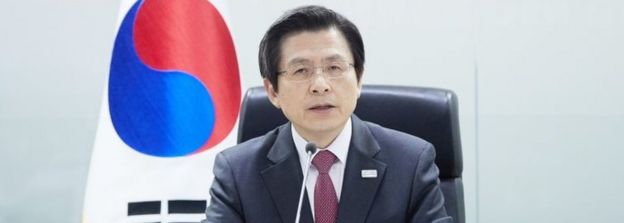
Acting S Korean president Hwang Kyo-ahnImage copyrightAFP
Image captionHwang Kyo-ahn has been standing in as president for three months

An election must now be held within 60 days, and the candidates have been waiting in the wings.
The new president will have to handle a public which has lost trust in the office, and come up with ways to stop such alleged abuses happening in the future.
Many South Korean analysts question whether Ms Park's conservative bloc will recover in time to post a viable threat to the Democrats.
Hwang Kyo-ahn has been acting president, but is not seen as a likely contender as he is too closely linked to the Park administration.
Moon Jae-in, the former head of the opposition Democratic Party, is one possible frontrunner. He lost to Park in the 2012 election and has been gaining popularity during throughout the impeachment scandal.

Could a president go on trial?

That is looking highly likely. Ms Park will now come under intense scrutiny from prosecutors, with no presidential immunity to protect her.
If she does go on trial, it will be over a case linked to one of her few close relationships.

Choi Soon-sil is taken into court in SeoulImage copyrightEPA
Image captionChoi Soon-sil has continued to insist she did nothing wrong

Her friend Ms Choi is already on trial for a string of corruption offences, as is the de facto head of Samsung, one of the companies alleged to have funnelled money through Ms Choi's charitable foundations to win political favour.
Everyone involved denies doing anything wrong.

What does it mean for the economy?

The case has rocked South Korea's business world, with the chiefs of Samsungand the national pension fund implicated in corruption.

Samsung acting chief Lee Jae-YongImage copyrightAFP

The scale of alleged bribery is colossal. Samsung alone is accused of paying bribes of 41bn won ($36m; £29m) to non-profit foundations operated by Ms Choi.
Heads of other big family-run conglomerates - known locally as chaebol - have also been questioned but not charged over donations given to similar foundations.
And some of the specifics, including Samsung admitting it spent about $1m on a horse for Ms Choi's daughter, have shocked Koreans.
But these are huge global companies. There is nothing so far to suggest that customers are turning away from them in South Korea, let alone around the world. Just this week, Samsung was confirmed as having comfortably held its title as world's biggest seller of smartphones in 2016.
Not bad in a year where its highest profile launch had to be recalled after batteries caught fire.
Realistically, a far bigger economic threat now are measures Beijing has taken in response to Seoul's decision to allow a US anti-missile system to be installed. They include closing down South Korean businesses in China and discouraging Chinese tourists form visiting South Korea.

What about other international relations?


North Korean media handout of missile launch (7 March 2017Image copyrightREUTERS
Image captionNorth Korea's repeated missile launches continue to rattle the region

Despite this shock, South Korea remains a stable democracy and economic powerhouse, so its relationships are unlikely to change. In many ways, the peaceful nature of the impeachment protests and the strength of rule of law play in the country's favour.
The US has just begun rolling out a massive missile defence system in South Korea to protect against North Korean attacks and that won't be affected, but the incoming president will have to quickly make friends with the Trump administration to shore up the much-needed military support given by the US.
A US spokesman told Reuters this was "a domestic issue" and the US remained "a steadfast ally, friend, and partner" to South Korea.
Japan - which withdrew its envoy from South Korea recently in a row about wartime sex slavery - said it "needs to promote co-operation" with the new government "in various areas".
North Korea's state media, which normally delays reporting international news, immediately reacted, calling Ms Park "a common criminal".
North Korea has always been scathing of Ms Park - often using her gender to attack her. That rhetoric won't end, but a new leader could potentially help reinvigorate international discussions on how to handle the South's increasingly tempestuous northern neighbour.