U.S. says Walt Disney subsidiaries to pay $3.8 million in back wages
A part of the signage at the main gate of The Walt Disney Co. is pictured in Burbank, California, May 7, 2012. REUTERS/Fred Prouser
Two Florida subsidiaries of Walt Disney Co have agreed to provide $3.8 million in back wages to comply with federal law, the U.S. Labor Department said on Friday.
The wages will be paid to 16,339 employees at the two units -- Disney Vacation Club Management Corp and Walt Disney Parks and Resorts U.S. Inc -- after U.S. officials found violations regarding minimum wage, overtime and record-keeping, the department said.
"The Department of Labor has identified a group of cast members who may have performed work outside of their scheduled shift, and we will be providing a one-time payment to resolve this," a Walt Disney World Resort spokeswoman told Reuters.
Disney's Parks and Resorts unit operates its parks and resorts around the globe, including the Florida-based Walt Disney World Resort.
"We are adjusting our procedures to avoid this in the future," the spokeswoman said in an email.
(Reporting by Susan Heavey in Washington and Aishwarya Venugopal in Bengaluru; editing by Diane Craft and Maju Samuel)
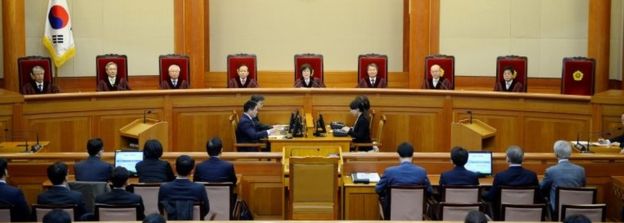
A South Korean court has voted to uphold an impeachment vote against President Park Geun-hye.
The ruling means Ms Park becomes the first democratically elected president to be removed from office, and could face prosecution over corruption allegations.
So what does this mean for the country?
First, what just happened?
Image copyrightREUTERSImage captionThe unanimous nature of the court ruling could help reduce public disquiet
The constitutional court backed an impeachment vote by parliament last December. It said the now ex-president's actions had "betrayed the people's confidence" and were "a grave violation of law, which cannot be tolerated".
Those actions were her alleged collusion with her close friend, Choi Soon-sil, to pressure South Korean companies into essentially buying favourable treatment from the government.
Ms Choi, who held no public office, also had extraordinary access to official documents, even editing some of Ms Park's speeches.
Ms Park has not had any presidential powers since December, when parliament voted to impeach her.
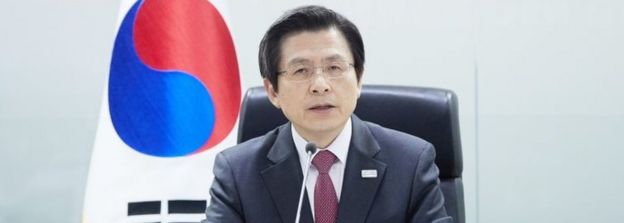
Image copyrightAFPImage captionHwang Kyo-ahn has been standing in as president for three months
An election must now be held within 60 days, and the candidates have been waiting in the wings.
The new president will have to handle a public which has lost trust in the office, and come up with ways to stop such alleged abuses happening in the future.
Many South Korean analysts question whether Ms Park's conservative bloc will recover in time to post a viable threat to the Democrats.
Hwang Kyo-ahn has been acting president, but is not seen as a likely contender as he is too closely linked to the Park administration.
Moon Jae-in, the former head of the opposition Democratic Party, is one possible frontrunner. He lost to Park in the 2012 election and has been gaining popularity during throughout the impeachment scandal.
Could a president go on trial?
That is looking highly likely. Ms Park will now come under intense scrutiny from prosecutors, with no presidential immunity to protect her.
If she does go on trial, it will be over a case linked to one of her few close relationships.
Image copyrightEPAImage captionChoi Soon-sil has continued to insist she did nothing wrong
Her friend Ms Choi is already on trial for a string of corruption offences, as is the de facto head of Samsung, one of the companies alleged to have funnelled money through Ms Choi's charitable foundations to win political favour.
The scale of alleged bribery is colossal. Samsung alone is accused of paying bribes of 41bn won ($36m; £29m) to non-profit foundations operated by Ms Choi.
Heads of other big family-run conglomerates - known locally as chaebol - have also been questioned but not charged over donations given to similar foundations.
And some of the specifics, including Samsung admitting it spent about $1m on a horse for Ms Choi's daughter, have shocked Koreans.
But these are huge global companies. There is nothing so far to suggest that customers are turning away from them in South Korea, let alone around the world. Just this week, Samsung was confirmed as having comfortably held its title as world's biggest seller of smartphones in 2016.
Realistically, a far bigger economic threat now are measures Beijing has taken in response to Seoul's decision to allow a US anti-missile system to be installed. They include closing down South Korean businesses in China and discouraging Chinese tourists form visiting South Korea.
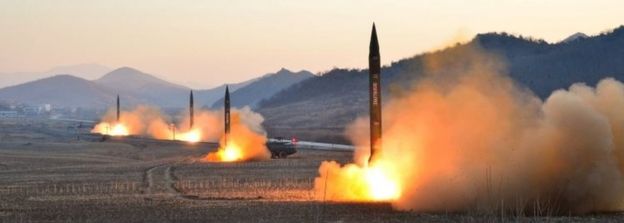
Image copyrightREUTERSImage captionNorth Korea's repeated missile launches continue to rattle the region
Despite this shock, South Korea remains a stable democracy and economic powerhouse, so its relationships are unlikely to change. In many ways, the peaceful nature of the impeachment protests and the strength of rule of law play in the country's favour.
The US has just begun rolling out a massive missile defence system in South Korea to protect against North Korean attacks and that won't be affected, but the incoming president will have to quickly make friends with the Trump administration to shore up the much-needed military support given by the US.
A US spokesman told Reuters this was "a domestic issue" and the US remained "a steadfast ally, friend, and partner" to South Korea.
Japan - which withdrew its envoy from South Korea recently in a row about wartime sex slavery - said it "needs to promote co-operation" with the new government "in various areas".
North Korea's state media, which normally delays reporting international news, immediately reacted, calling Ms Park "a common criminal".
North Korea has always been scathing of Ms Park - often using her gender to attack her. That rhetoric won't end, but a new leader could potentially help reinvigorate international discussions on how to handle the South's increasingly tempestuous northern neighbour.