Friday, February 17, 2017

Indonesia police chief: Woman tricked into attack on Ki

Indonesia police chief: Woman tricked into attack on Kim

The Canadian Press 

Wednesday, February 15, 2017

The fallout over the resignation of Michael T. Flynn,

Today's WorldView

THE TAKEAWAY

The fallout over the resignation of Michael T. Flynn, President Trump's national security adviser, is still settling over Washington. Reporting by my colleagues on Monday night seemed to make Flynn's position in the White House untenable. They revealed that officials from the Justice Department had warned the Trump administration that Flynn had likely misled the White House regarding his conversations with the Russian ambassador — and that he was potentially vulnerable to Kremlin blackmail. After a steady drumbeat of speculation, Flynn tendered his resignation just before midnight.
With Flynn's departure, the intrigue only deepensMany questions still need to be answered: Why did Trump, who apparently was aware of Flynn's dissembling for weeks, wait so long to force his adviser out? What did Trump himself know directly about Flynn's conversations with Russian officials? Did Flynn potentially make false claims to the FBI, who quizzed him in the first days of the administration? Could Flynn face prosecution?
Democratic politicians — and even some Republicans in Congress — are urging an investigation into the Flynn affair and the Trump camp's wider connections to Russia. After all, two other top Trump aides left their posts ahead of last year's election likely because of ties to Moscow.
Russian lawmakers conspicuously rushed to Flynn's defense on Tuesday, with some claiming his ouster was due to the Russophobia endemic to Washington.
But Flynn, a once-respected military officer turned political maverick who joined Trump early in his campaign, is guilty of acting on his own phobias. Long before his ties to Russia came under question, Flynn was known for harboring an extreme anti-Muslim worldview and for peddling Islamophobic conspiracy theories.
It's likely that Trump's fire-and-brimstone rhetoric about the war against "radical Islam," and his seeming declaration of a clash of civilizations, is in part informed by the views of Flynn and other zealots in the administration.
Flynn, Bannon and others have all, at various points, warned about a phantom Islamic takeover of the United States. In their zeal to crush jihadism, they train their attacks on Islam — a religion of more than a billion adherents — as a whole.
"Islam is not a real religion, but a political ideology masked behind a religion," Flynn claimed. He has repeatedly raged against the supposed "political correctness" of those who fear his rhetoric may alienate millions of Muslims, including American citizens.
"We’ve got to stop feeling the slightest bit guilty about calling them by name and identifying them as fanatical killers acting on behalf of a failed civilization," Flynn wrote in his book, "The Field of Fight: How We Can Win the Global War Against Radical Islam and Its Allies," which was published last year.
"In the parlance of the day," observed Post book critic Carlos Lozada, "one might say Trump’s national security adviser is normalizing holy wars."
The key distinction between the outlook of the Flynns and Bannons of the world and their predecessors in earlier administrations is that the former genuinely believe radical groups like the Islamic State represent the real face of Islam. The latter generally treated jihadists as aberrations who gained power amid the dysfunction of failing states.
Yet the vague policy measures so far prescribed by Trump and Flynn to defeat the Islamic State are not that different from those practiced by the Obama administration they loathe: Namely, bombing campaigns, the cultivation of local allies and taking the battle of ideas to cyberspace.
Syrian opposition fighters said&nbsp;these&nbsp;men pictured north of Raqqa in May 2016 were members of US special operations forces. (Delil Souleiman/AFP)</p>
Syrian opposition fighters said these men pictured north of Raqqa in May 2016 were members of US special operations forces. (Delil Souleiman/AFP)

What's different is the all-out embrace of a culture war, which seems at this point to be the signature political tactic of the Trump administration. You can draw a straight line from the extreme views of Flynn and others in the White House to Trump's travel ban on refugees and immigrants from seven Muslim-majority countries — a move stymied in the courts in part because it reflected thinly-veiled bigotry.
That Flynn's views didn't automatically disqualify him from such a vital and strategic post in the world's most powerful government speaks volumes about the deep Islamophobia within the Trump administration. Not surprisingly, Muslim rights groups cheered Flynn's departure on Tuesday.
"We welcome Michael Flynn's resignation and hope it is followed by that of all the other anti-Muslim bigots currently formulating domestic and international policies in the White House, including Steve BannonStephen Miller and Sebastian and Katharine Gorka," said Nihad Awad of the Council on American-Islamic Relations, in a statement. "Our nation is best served by those who base their policy recommendations on facts, not fear."

Kim Jong-nam death: Malaysia police hold female suspect

Kim Jong-nam death: Malaysia police hold female suspect


  •  
  • From the sectionAsia

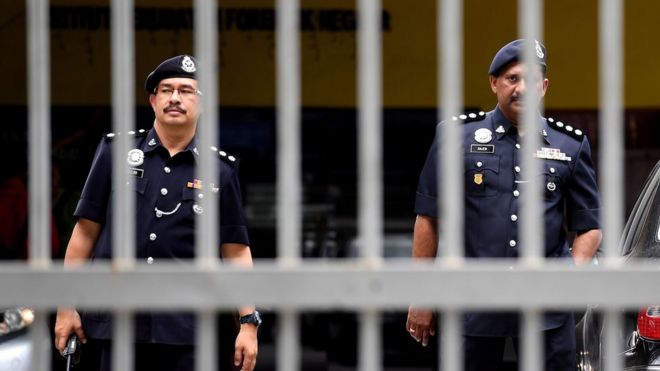
Senior Malaysian police personnel walk outside the Forensic wing at the Hospital Kuala Lumpur on February 15, 2017Image copyrightAFP
Image captionMalaysian police have been hunting for suspects in connection with the mysterious death on Monday

A female suspect has been arrested in Malaysia in connection with the death of North Korean leader Kim Jong-un's half-brother.
Local police said that the woman was arrested at the airport in the capital Kuala Lumpur where Kim Jong-nam was targeted in an apparent poisoning on Monday.
She was in possession of a Vietnamese travel document.
Malaysian police say they are looking for "a few" other suspects.
Police said the arrested suspect, who was alone, was identified from CCTV footage taken at the airport. They named her as Doan Thi Huong, 28.
South Korean media have widely reported that two women, said to be North Korean agents, were involved and fled the airport in a taxi, though Malaysian police have not confirmed those details.
A grainy image broadcast in South Korea and Malaysia shows a woman wearing a white T-shirt with the letters "LOL" written on the front.

Grainy image shows a woman with brown hair wearing a T-shirt with the letters Image copyrightREX/SHUTTERSTOCK
Image captionThis CCTV image has been broadcast by South Korean and Malaysian media

Malaysia is yet to formally confirm that the dead man is Kim Jong-nam, as he was travelling under a different name - Kim Chol. But the government of South Korea has said it is certain it is him.
Its spy agency is said to have told lawmakers they believe Mr Kim was poisoned.
Earlier, Malaysia state news agency Bernama reported that a woman from Myanmar was detained at the airport. It is unclear if that report was referring to the woman now under arrest.

Kim Jong-nam wearing a leather jacket and baseball capImage copyrightAFP
Image captionKim Jong-nam has kept a low-profile in recent years

If confirmed, it would be the most high-profile death linked to North Korea since Kim Jong-un's uncle, Chang Song-thaek, was executed in 2013.
North Korea has not commented on the death but officials from the country's Malaysian embassy have been visiting the hospital in Kuala Lumpur where Mr Kim's body has been taken.

What happened?

Kim Jong-nam was attacked on Monday morning while waiting at the budget terminal of Kuala Lumpur International Airport for a 10:00 flight to Macau, Malaysian newspaper reports say, quoting police.
Exactly how the attack unfolded is still unclear. Officials and witnesses have variously said he was splashed with a chemical or had a cloth placed over his face. Earlier reports spoke of a "spray" being used or a needle.
He died on the way to hospital.

Who was he?

It was not the first time Mr Kim had travelled under an assumed identity: he was caught trying to enter Japan using a false passport in 2001. He told officials he had been planning to visit Tokyo Disneyland.
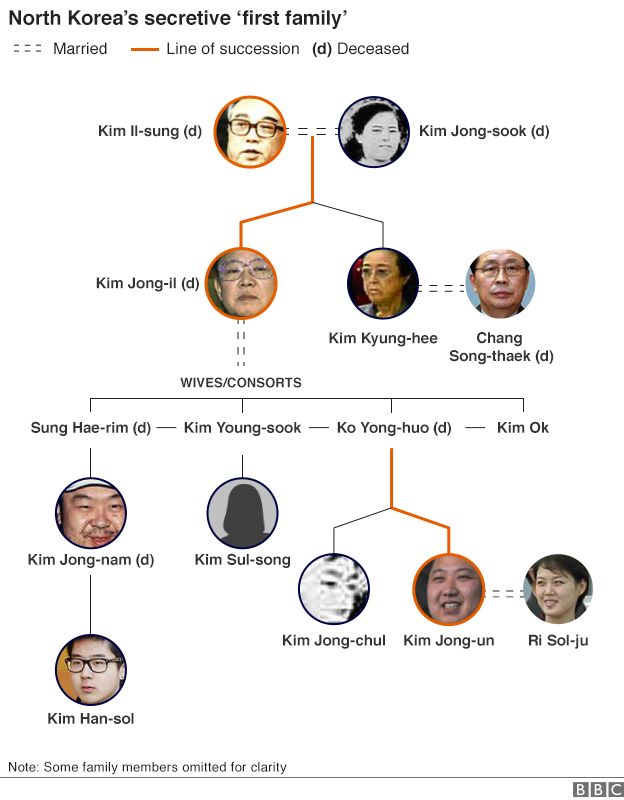
The Tokyo incident is thought by some analysts to have spoilt Kim Jong-nam's chances of succeeding his father, Kim Jong-il, who died in 2011.

North Korean family tree showing Kim Jong Nam as the son of Kim Jong-il and Sung-Hae-rim

Bypassed in favour of his youngest half-brother for succession, Kim Jong-nam kept a low profile, spending most of his time overseas in Macau, mainland China and Singapore.
He later spoke out against his family's dynastic control of North Korea and in a 2012 book was quoted as saying he believed his younger half-brother lacked leadership qualities.
But he had said he was not interested in assuming the leadership himself.

Was this an assassination?

Unnamed US government sources have said they believe he was poisoned by North Korean agents.
South Korean spy chief Lee Byung-ho told South Korean MPs that Pyongyang had wanted to kill Kim Jong-nam for several years, but that he was being protected by China.
But some analysts question what motive Kim Jong-un would have to kill his estranged half-brother, given the risk of the operation and possibilities for embarrassment, and the fact that he was not seen as a threat to Mr Kim's leadership.
Still, Mr Kim was reportedly targeted for assassination in the past. A North Korean spy jailed by South Korea in 2012 is said to have admitted trying to organise a hit-and-run accident targeting him.
The secretive state has a long history of sending agents overseas to carry out assassinations, attacks and kidnappings.

Monday, February 13, 2017

Apple hits record high but leaves some investors in dust


Apple hits record high but leaves some investors in dust


By Noel Randewich | SAN FRANCISCO
Apple (AAPL.O) shares cruised to a record-high close Monday, helping catapult the S&P 500 stock index over the $20 trillion mark in what amounts to a victory for plain-vanilla mutual funds over a bevy of hedge fund managers who recently backed away from the iPhone maker.
The largest component of the S&P 500 and a core holding on Wall Street, Apple's stock climbed 0.9 percent to end at $133.29, above its record high close of $133.00 hit on Feb. 23, 2015 and giving it a market value of about $699 billion.
Its increase helped balloon the S&P 500's .SPX market capitalization on Monday beyond $20 trillion for the first time.
While mutual funds have largely bet on Apple in recent months, some big names missed out on all or part of its recent acceleration.
Hedge fund manager Dan Loeb's Third Point LLC cut its stake in Apple by 26 percent to 1.9 million shares in the fourth quarter, according to regulatory filings, while George Soros and Carl Icahn also shed their Apple shares last year.
In contrast, the number of mutual funds reporting they became Apple shareholders in recent quarterly filings has jumped by 187 percent to 287, while the number of mutual funds liquidating their Apple holdings dropped by 26 percent to 151, according to Morningstar.
Among the big names who backed the stock, Warren Buffett's Berkshire Hathaway (BRKa.N) last August said it had increased its stake in Apple by 55 percent to 15 million shares, now worth $2 billion. David Einhorn's hedge fund Greenlight Capital in January said it still likes Apple.
Apple has climbed 50 percent from lows in the first half of last year and is up 15 percent so far in 2017. It was still short of its all-time intraday high of $134.54, set on April 28, 2015.
Monday's gain came after Goldman Sachs analyst Simona Jankowski raised her price target for Apple to $150. She said she is more confident that an upcoming 10th anniversary iPhone will feature augmented-reality technology, which could help boost demand in a saturated smartphone market.
Many investors are betting that Apple will mark the iPhone's 10th anniversary with a dramatically improved model. They also believe that strong sales of the iPhone 6S two years ago have left a larger-than-normal base of customers ready to upgrade.

The Cupertino, California company reported strong December-quarter results on Jan. 31, and although it gave a cautious outlook for the current quarter, Wall Street expects revenue to grow this year after sinking nearly 8 percent in fiscal 2016.
In 1998, when the S&P 500 closed above $10 trillion for the first time, Apple accounted for just under 0.06 percent of the index. It now accounts for about 3.5 percent of the S&P 500, according to S&P Dow Jones Indices.
The 721 days that have passed since Apple's previous record-high close represent the largest gap between such milestones since the iPhone's launch in 2007.
(Reporting by Noel Randewich; Editing by James Dalgleish)

Exclusive: Retail CEOs head to Washington to try to kill U.S. border tax - sources


Exclusive: Retail CEOs head to Washington to try to kill U.S. border tax - sources


left
right
FILE PHOTO - Cranes and containers are seen at the Ports of Los Angeles and Long Beach, California February 6, 2015 in this aerial image. REUTERS/Bob Riha Jr
1/3

By Ginger Gibson | WASHINGTON
Chief executives of some of America's largest retailers, including Target Corp (TGT.N) and Best Buy Co Inc (BBY.N), are headed to Washington this week to make their case that a controversial tax on imports would raise consumer prices and hurt their businesses, according to people familiar with the plan.
The group of eight retail bosses, that also includes chief executives of Gap Inc (GPS.N) and Autozone Inc (AZO.N), will meet on Wednesday with Kevin Brady, chairman of the tax-writing House Ways and Means Committee, and with members of the Senate, four people said in recent days. Reuters could not confirm the full list of participants.
This is the first time well-known retail CEOs will descend on Washington as a group to try to make the case to kill the import tax proposal. Their input has more urgency as U.S. President Donald Trump is finalizing his own tax plan that he plans to unveil in the coming weeks.
It is not known if the group, including Target CEO Brian Cornell, Best Buy CEO Hubert Joly, GAP CEO Art Peck and Autozone CEO William Rhodes, will meet with Trump at the White House while in town, according to people familiar with ongoing discussions.
Brady and Speaker Paul Ryan are leading a House Republican push that would cut corporate income tax to 20 percent from 35 percent, exclude export revenue from taxable income and impose a 20 percent tax on imports. Companies that rely heavily on imports, such as retailers, automakers and refiners say a border tax will outweigh the benefit of a lower headline corporate tax.
Asked for confirmation of the meeting, Brian Dodge, a spokesman for the Retail Industry Leaders Association, told Reuters there was going to be a meeting this week but declined to provide further details.
The trade group is leading the industry's effort to oppose House Republicans' proposal for a border adjustability tax, running a coalition of more than 120 companies and trade organizations including Wal-Mart Stores Inc (WMT.N) and Walgreens Boots Alliance Inc (WBA.O).
Representatives for Target, Best Buy, Gap and AutoZone did not respond to requests for comment.
Trump has voiced some concern about the House tax proposal calling it "too complicated." But the White House also said previously that a border tax on goods from Mexico is one option under review to pay for a wall along the nation's southern border.
The prospect of a big import tax is also pitting some of the largest U.S. companies against one another. A group of major exporters including Boeing Co (BA.N), General Electrics Co (GE.N) and Pfizer Inc (PFE.N) have formed their own coalition to support the import tax.

Retailers have become the most vocal opponents to the proposal, saying a 20 percent tax on imported goods would cause prices to increase for consumers and erase any profits the companies currently make. Nearly all of the nation's clothing, shoes and electronics are imported into the United States, as well as foods that cannot be grown domestically, like coffee and palm oil.
The largest U.S. electronics retailer, Best Buy, for example, has circulated a flyer to lawmakers, which cites an analyst forecast that a 20 percent tax would wipe out the company's projected annual net income of $1 billion and turn it into a $2 billion loss.
(Reporting by Ginger Gibson in Washington; Additional reporting by David Shepardson; Editing by Soyoung Kim and Lisa Shumaker)