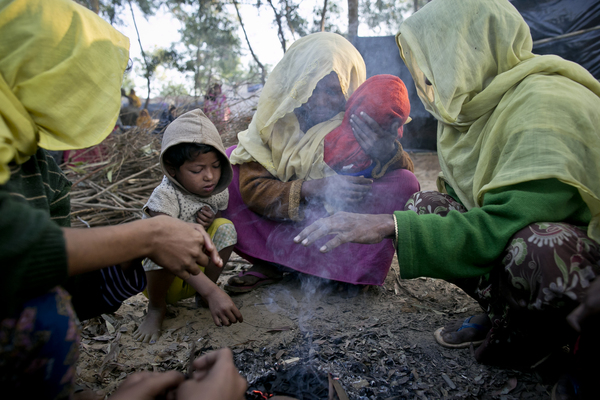
A Rohingya family warm themselves by a fire in the Balu Kali refugee camp in Bangladesh on Jan.19. (Allison Joyce/Getty Images)
Slaughter in Burma
A grim reality is becoming more and more apparent in Burma: the country’s Rohingya ethnic minority is being systematically wiped out.
Two separate United Nations officials told Reuters this week that the Burmese military is carrying out an ethnic cleansing, citing testimonies from survivors who’ve crossed into neighboring Bangladesh.
The officials estimated that at least 1,000 Rohingya have been killed in the past few months, a much higher number than previously thought. But that figure, they warned, is just “the tip of the iceberg.”
The Rohingya are a mostly Muslim, Bengali-speaking ethnic group. They have lived in coastal Burma for generations, but many in Burma’s Buddhist majority see them as unwanted interlopers from Bangladesh. Burma denies them citizenship, rendering them stateless.
The military and the police also claim that many Rohingya are Islamic extremists. A December 2016 report by the International Crisis Group lends the accusation some credence. It found evidence that a group of Rohingya militants called Harakah al-Yaqin (“the Faith Movement”) has several hundred recruits, popular support and funding from the Rohingya diaspora in Saudi Arabia and Pakistan.
For months now, scattered reports of razed villages, mass rapes and killings have reached the outside world through escapees. Roughly 70,000 Rohingya have sought refuge in Bangladesh since October, but they are also not welcome there and many have been sent back to Burma. The U.N. officials said most of the refugees arriving in Bangladesh in the past couple months have been women and children, telling stories of dead husbands and sons.
Global outcry has been muted, in part because Burma is still emerging from nearly 50 years of military rule, and Nobel Peace Prize winner Aung San Suu Kyi is now one of the country’s most powerful political leaders. Suu Kyi has to walk a fine line: questioning the military could derail Burma’s political transition.
Beyond the officials’ accounts, it’s hard to quantify just how bad the situation has become. Aid groups and journalists have no access to Rohingya villages in Burma, and independent verification is more or less impossible. It may be years until the full extent of the violence is known. — Max Bearak

No comments:
Post a Comment